22.07.2026
Beyond Code: Cross-Functional Skills Are the True Superpower in the Age of AI
Audience seated at a tech event in front of a blue backdrop that reads 'BEYOND THE CODE' with a large display screen to the right and balloons overhead.
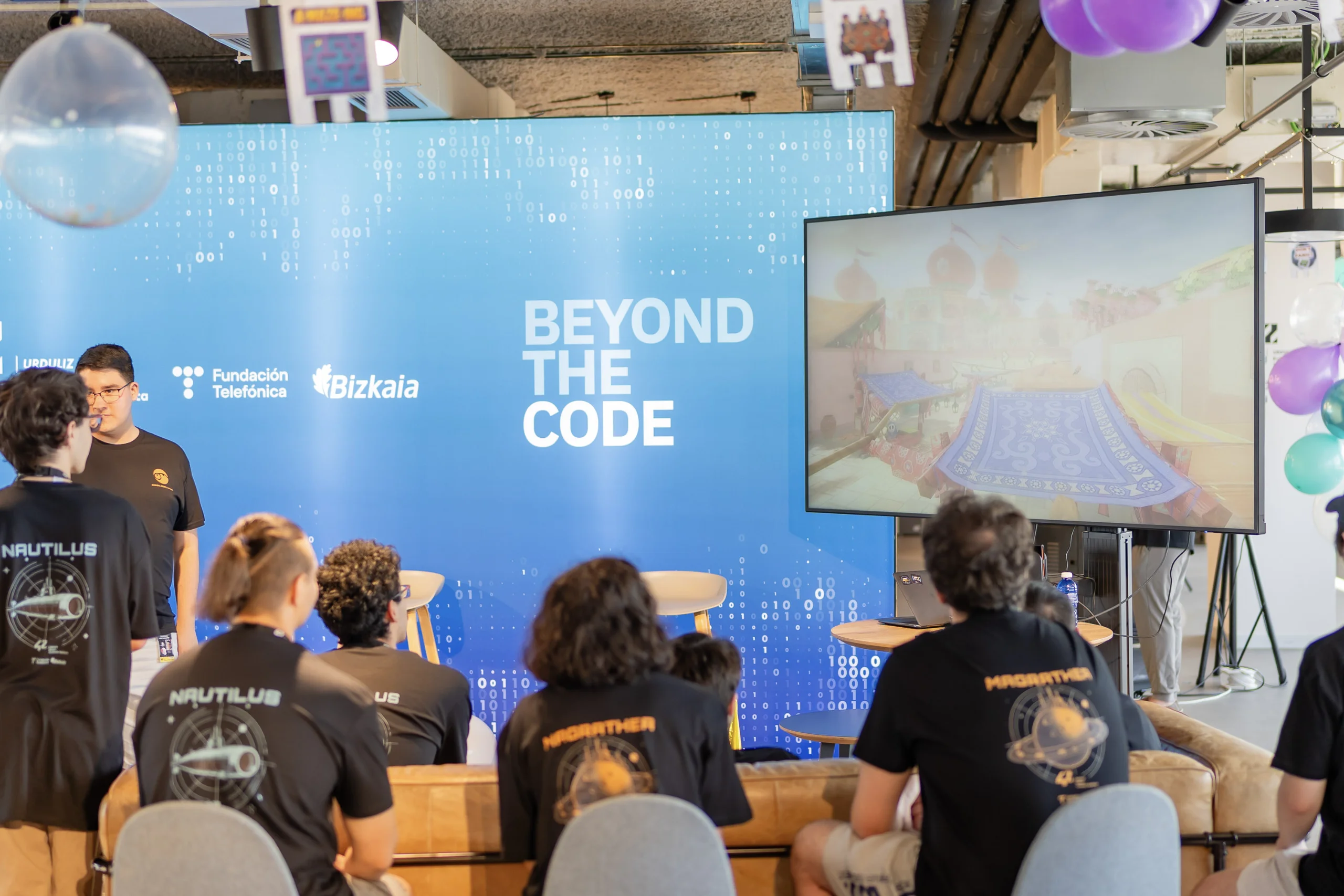
Digital employment is not just about mastering the latest programming language or knowing the most advanced tools for improving productivity. In an increasingly technology-driven labour market, companies also value skills that enable people to work effectively in changing and collaborative environments. In fact, so-called soft skills are carrying increasing weight in recruitment processes, as reflected in the vacancies published on the technology-specialised job portal tecnoempleo.com.
These skills refer to people’s ability to adapt to change, communicate effectively, work in a team, solve problems, lead judiciously and create value in organisations where technology is a tool, but decisions and relationships continue to depend on human talent. In the age of artificial intelligence, it is precisely these skills that enable the potential of technology to be harnessed in a critical, ethical and responsible manner.
Although these skills are valuable in any professional field, technology-related roles have characteristics that make some of them particularly relevant. The rapid pace at which technologies evolve, the need for continuous learning and the requirement to work in multidisciplinary teams mean that companies are seeking professionals who, in addition to possessing solid technical knowledge, are capable of adapting, collaborating and exercising sound judgement in complex environments. Whether you work as a software developer, cybersecurity specialist, data analyst, DevOps engineer, systems administrator or technology consultant, these are some of the cross-cutting skills most highly valued by companies:
1. Effective digital communication
Communication skills are essential; receiving, processing and passing on information to others is part of any professional’s day-to-day work. But in the tech sector, where communication takes place via video calls, chats and asynchronous messages, knowing how to convey or request information clearly and with empathy is vital.
Furthermore, in multidisciplinary teams, effective communication also involves knowing how to adapt the message to different audiences. For example, conveying technical concepts to business, marketing or communications teams in an understandable way, whilst also understanding the needs and priorities of non-technical departments.
In digital environments, it is essential to:
– To express ideas concisely.
– To make appropriate use of the various communication channels, both face-to-face and digital (emails, chats and video conferences).
– To listen actively.
2. Technological adaptability
No sector is more dynamic than the digital sector; just a few years ago, no one could have anticipated the emergence of technologies such as generative Artificial Intelligence, and attempting to make predictions about the future seems a risky exercise.
Just a few years ago, it was difficult to imagine the impact that tools such as ChatGPT, GitHub, Copilot or Claude would have on the day-to-day lives of thousands of professionals. In a few years’ time, new ones will emerge that will once again transform the labour market.
This is why the ability to adopt new tools, technologies or ways of working is essential, and it is one of the most highly valued cross-cutting skills.
3. Collaboration in hybrid and distributed environments
It is becoming increasingly common to have to work with colleagues or clients not only in different physical locations, but also across different time zones or cultures. Knowing how to turn this into an advantage rather than a drawback will make us highly sought-after candidates in the job market.
4. Critical thinking regarding digital information
The internet has put all information at our fingertips; now, with Artificial Intelligence, we have taken this trend to the extreme. We have the answers to any question just a prompt away.
But are we able to distinguish high-quality answers from everything that AI can generate? It is this critical thinking – this ability to separate the signal from the noise – that is an essential skill for turning AI tools into a superpower, rather than allowing them to act as mere intermediaries.
5. Digital emotional intelligence
Emotional intelligence – the ability to recognise, understand and manage your own emotions and those of others – has been what has set leaders apart throughout history. But in an environment mediated by screens, video calls and one-line messages, how can we ensure we are correctly interpreting the messages we receive?
6. Time management and digital productivity
Time management and digital productivity have become an essential cross-cutting skill because today’s labour market demands working efficiently in increasingly digital, collaborative and fast-changing environments. It is not about doing more in less time, but about organising work intelligently, using digital tools that enable you to prioritise tasks, manage information, collaborate with others and meet objectives effectively.
In the tech job market, companies value this skill because it is directly linked to efficiency, autonomy, adaptability and productivity. A professional who knows how to manage their time and make the most of digital resources not only works better, but also responds more quickly to changes, coordinates their work more effectively with others and helps the organisation achieve its objectives.
7. Use of Artificial Intelligence
Artificial Intelligence is already part of the daily work of thousands of professionals in the technology sector. It is not simply a matter of using ChatGPT or other AI tools, but of knowing how to integrate them intelligently into the workflow. This involves formulating good prompts, validating the responses obtained, detecting potential errors or biases, and deciding when to rely on an automated recommendation and when to draw on professional judgement.
In the labour market, this skill is valuable because it enables the automation of repetitive tasks, the analysis of information, the generation of first drafts, the exploration of alternatives and the acceleration of certain processes. However, the real difference lies not simply in using a tool, but in knowing when to use it, for what purpose, with what information and how to verify the result.
Two players, a bearded man with long hair and a man with short hair, lean over a chessboard in a bright indoor setting, concentrating on the game.

In a constantly changing labour market, it is no longer enough to acquire technical knowledge or master a specific profession. As we have seen throughout this post, companies are increasingly seeking candidates capable of adapting to change, working collaboratively, managing digital tools, developing critical thinking and using technologies such as artificial intelligence responsibly. Consequently, training in transferable skills has become a key differentiator for improving employability and successfully tackling the challenges of the present and the future.
In this context, OrientaHub becomes a valuable ally by offering personalised guidance on the professions and profiles most in demand in the labour market, as well as information on the technical and soft skills required to enter these fields. In this way, people can identify opportunities for development, design training pathways in line with their career goals, and prepare for an increasingly dynamic and digital labour market.